Archive for the 'movies' Category


booksmoviesbooksmovies

Yesterday we finally saw The Girl with the Dragon Tattoo at Sundance.  In short, it was well done and faithful to the book.  They edited a lot from the book, but everything they took out made a lot of sense to me.  They added a couple of things, but the things they added made me think, “Wait, was that in the book?” as opposed to, “There’s no way that would ever have happened!”  So, again, it was a very faithful, respectful adaptation.

It’s interesting when really popular books are made into movies.  It can’t be easy.  I remember an interview with Emma Thompson in which she was talking about the difficulty of adapting Sense and Sensibility.  She said that while she was on a plane, the passenger next to her was going on and on about her favorite scene from the book and couldn’t wait to see what Thompson had done with it on the screen.  Well, it turned out, Thompson had cut that part altogether.  Oops.

Thompson’s Sense and Sensibility is a good place for me to start with my books-to-movies pontification.  I have always wanted to slap the criminally wanna-be elites when they moan on about how movies are never, ever as good as whatever book that spawned them.  I think this is a horrifically ignorant stance and just, well, nonsensical.  Why would a book be inherently better than another art form?  Because reading is somehow just ‘better’ than film?  Why?  I don’t buy it.  What I do buy, though, is that when a director and screenwriter are making a movie out of a beloved book, they are treading on dangerous ground.  But it can be exciting ground.

Sense and Sensibility is a much better movie, in most ways, than it is as a book.  Thompson’s S&S is made as if Austen had written her story at the end of the career, as opposed to the beginning.  It is more sophisticated, cleaner and more polished than Austen’s first novel.  I truly think that Austen would not only approve, but applaud.

A River Runs Through It is a great book.  It’s a compelling, and short, autobiography of Norman Maclean and his life in western Montana.  The thing is, though, as beautiful as the words in the book are, and as artfully as his sentences are constructed, a major character in the book — if not the major character — is Montana.  Seeing the story on the screen brought everything into sharp focus.  It became clear that the book was not only the unfolding story of the tragic figure of Maclean’s brother, but a love poem to Montana.  And Redford captured this brilliantly.  It is magic to behold.

Now, The Girl with the Dragon Tattoo is a good book to be sure.  But it is not A River Runs Through It and it is surely not my beloved Jane.  But I think some of the points are the same.  It is a wildly popular modern book that has been eagerly anticipated in film-form.  As I said, the story that we saw yesterday was very faithful to Larsson’s story.  For the most part, I really liked the film. 

Lisbeth Salander is beautifully played by Noomi Rapace.  I think people were probably most worried about the portrayal of Salander since she is by far the most compelling feature in a thoroughly compelling book.  But Rapace really nailed her.  Though she looked a little like Marilyn Manson at times, which scared me, I think that was probably the point.  Blomkvist was also perfectly cast in Michael Nykvist — he looked almost exactly as I thought he should look.  Aaron thought he looked like Mayor Dave.  I can see that, but more if Mayor Dave lived a much harder life. 

For me, Sweden was a really big part of the book and I wanted more Sweden in the movie – more shots of Salander walking down the streets of Stockhom.  Aaron pointed out that maybe for Swedes, Sweden didn’t seem to play as big of a role in the novel so that the film didn’t need to reflect it.  It’s a good point.  I don’t know.  I know that I did want, though, an ariel shot of the Vanger island.  I wanted a map of it in the book, which I didn’t get, so I was really hoping for a better sense of it in the film, which also didn’t happen.  That said, I loved the buildings they chose to represent this space.  They were truly brought to life and I felt like I was seeing into a world I’d been able only to imagine before.  Mainly because that’s what I was doing, really. 

What really struck me about the film, though, is the violence.  I hadn’t really prepared myself for that.  Obviously I was aware that the book was violent, but just as I had been aware that A River Runs Through It is about Montana, I wasn’t ready for what that would mean when I would see it brought to life.  I could not watch — and I mean I literally did not see a single part of — the scene in which Salander’s guardian assaults her.  I could barely stand the sound of hearing it.  I closed my eyes, put my head in my shirt, put my hands over that and clenched down on a rolled-up napkin.  It hurt.  It was nauseating.

Adapting a film from an iconic book can be a great thing.  It can be great to see all of those characters as actual people.  And it can be awesome to see the scenes unfold before your eyes.  And it can be terrifying, too.

Phew!

I really should have written as I went along, but since I was sick for most of the festival, just attending the films seemed like enough.  Now I have given myself the difficult task of recapping the past five days.  Because what fun is the film festival without being able to write about it?  Well, actually, it’s pretty fun either way.  The Wisconsin Film Festival, I do declare, is the BEST festival in the universe.  And I’ve been to Carnival in Venice and  Oktoberfest in Munich and Sundance in Park City.  Ha.  Ok, but I am serious — it runs so smoothly, there are a ton of great movies and the venues are mostly awesome and you can walk from one to another unlike, say, Sundance.  It has the added advantage to have been held on a gorgeous April weekend.  First outdoor Farmer’s Market of the season, spring game, New Heather was in town…Ah, there is nothing like Madison in spring.  I just love it.  Now, to the films.  And I apologize in advance for the long post.  But there’s a lot to say as there was a lot to see.

We bought tickets to 14 films, knowing that we wouldn’t make it to them all.  As my Dear Reader knows, I tend to need an “opt out” button in nearly everything I do.  This includes even things that I love, like the festival.  I need to be able to skip things.  So, we made it to 11 movies and I think that’s great.

Number one movie of the festival in both senses — it was the first movie we saw and I dare say it was the best.  At least it wins Kate’s Official Selection for Best Documentary.  And who wouldn’t want that award?  It’s called The Art of the Steal and it was produced by IFC so I imagine it will be widely distributed.  The movie was screened in a sweet little movie theater in the Overture Center/MMoCA that I had no idea existed.  It’s the story of Albert Barnes and his enormously wonderful collection of art, which is currently housed in the appropriately named Barnes Foundation in Merion, PA, outside Philadelphia.  The story traces Barnes’ life and his preeminent desire to keep his collection housed in the mansion he built in Merion and outside the hands of the Philadelphia art world.  As you may have guessed from the title of the movie, or if you know this story, his efforts and his will have been usurped by self-interested politicians and “charitable” groups who assert their good intentions.  Excellent movie.  It made me ask questions such as who has the right to see privately-owned art, if anyone; when should a person’s will be ignored, if ever; what interest do these huge charitable foundations really serve; and why have I not heard about this amazing collection earlier.  I gave it a 5 (the fest hands out ballots and viewers get to rate the movies on a scale of 1 to 5), of course, though I was tempted to give it a 4 just because the ending is so upsetting.

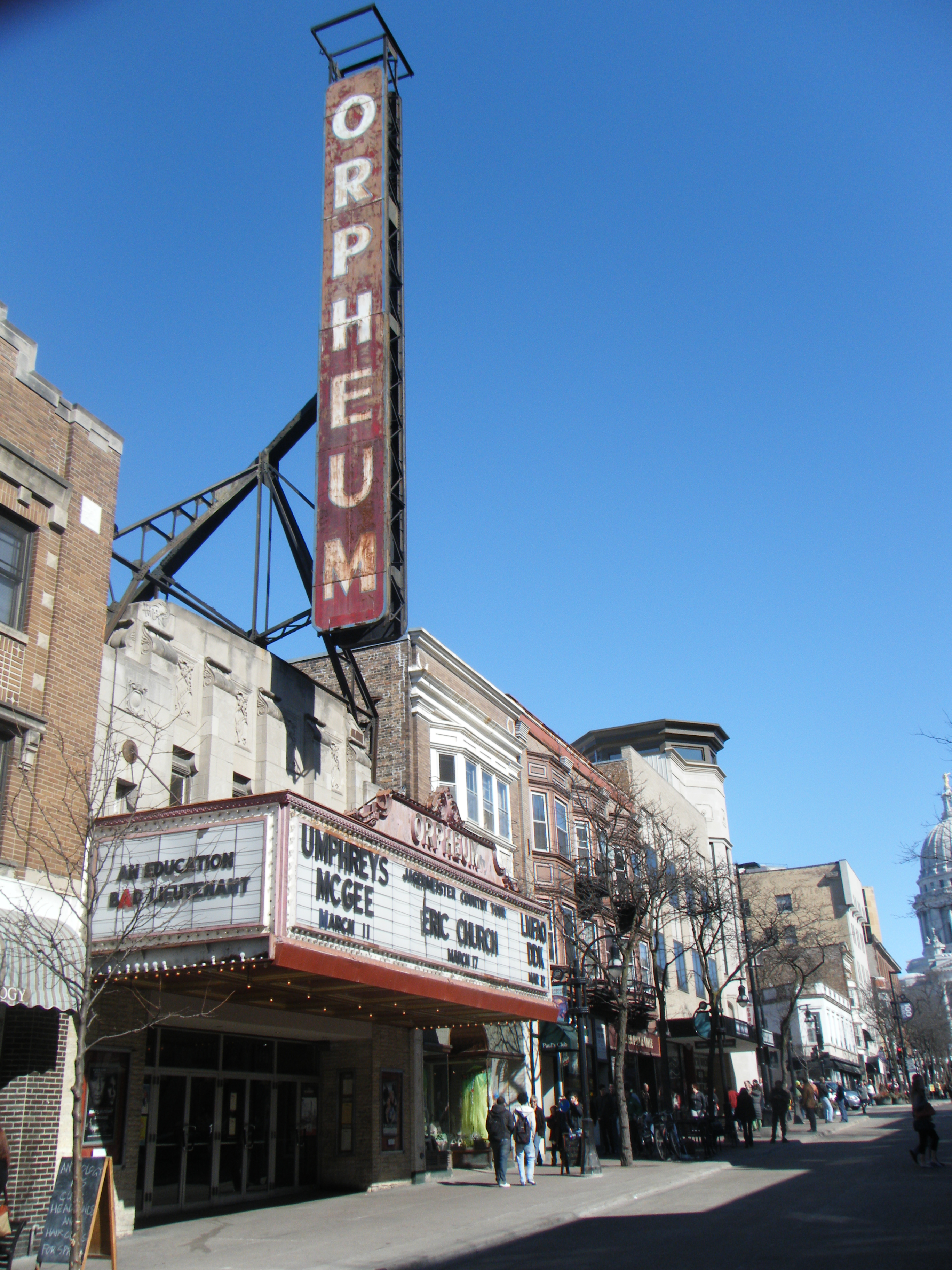
Next we saw the newest OSS movie: OSS 117:  Lost in Rio, which is a French parody of spy movies and is, as its predecessor was, hilarious.  It was fun to see at the Orpheum and the house was packed.  A fun 4.

Then we hit a bit of a road bump.  We saw Cooking History at the Wisconsin Union Theater.  Sidenote: I almost always forget how much I love that theater.  It’s just gorgeous — art deco-y and so cool.  Great place.  Cooking History, we thought, was going to be a light-hearted look at cooking for soldiers during war time.  I know that that must sound really stupid and naive, and rereading the description I see now that we kind of made that up, but it’s what I had envisioned.  Instead it’s pretty much a depressing tale about people who cooked during Europe’s nastiest wars.  And it really doesn’t say too much about the cooking.  And it’s laden with Eastern European and German languages so I found myself audibly breathing relief when the French came on the scene.  Gosh I really don’t like those icky “Schiepa, Ein, Schma, Tannenbaum” sounds.  Anyway, in all, I really have no idea what this movie was about and gave it a 2 because it didn’t totally stink, but it was a bit of a dud.

We rebounded nicely, though, when we walked back up State Street to the Orpheum to see The Most Dangerous Man in America, which is about Daniel Ellsberg and the Pentagon Papers.  This movie was exactly what you’d expect: a movie about Daniel Ellsberg and the Pentagon Papers.  It was really interesting as I learned that I had previously known very little about Ellsberg.  I gave the film a 4 because, while it was rivetting, I became confused a few times.  Wait, who’s that guy?  Wait, when was he a marine?  Wait, why couldn’t the FBI find him?  Anyway, it was a pretty perfect documentary.  It was no The Art of the Steal, but it had a lot of those elements you really want — a real hero, intrigue, Nixon swearing, etc — in a movie.

So, those were the ones we saw on Wednesday and Thursday.  Friday brought us to Human Terrain and Harmony & Me.  The former was billed as a documentary about the military’s training ground in the California desert that serves to mimic the conditions in Iraq and to act as a role-playing model for the soldiers.  Instead, the movie was really more about this one particular social scientist who decides to work for the military and be sent to Afghanistan in his effort to reduce the human toll the war has taken.  The movie explores the role of social scientists/anthropologists in war, which is an interesting question no doubt.  Should social scientists remain purely academic and stay out of the conflicts or do they have a duty to act and to try to change outcomes?  I gave it a 3 because it was an ok movie, but I felt misled.  Additionally, it really didn’t become clear that the movie was asking those questions, and centering on this one particular man, until about half-way or two-thirds of the way through.  Harmony & Me, on the other hand, was a delightful tale about a guy who can’t get over his ex.  Familiar terrain, yes, but light and cute and bright and fun.  It elicited true laughs from the crowd and true feeling.  A solid 4.

Saturday we hit three movies, all at the Orpheum.  We were sort of on a conveyor belt…Get in line for the 11 o’clock show, see the movie, exit; get in line for the 1:15 show, see the movie, exit; get in line for the 3:30 show, see the movie, exit.  The first movie was Sweetgrass, which is the tale of modern-day Montana shepherds who move sheep across many miles (why? I don’t really know.  We missed the first few minutes) of public land.  There is very little dialogue and even that which there was, it was hard to understand.  Except for the one cowboy/shepherd who curses at the sheep so severely that I worried there would be scarred children in the audience.  Mostly it’s just a really beautiful picture of Montana punctuated by lots of “BAAAAA!”s.  I found myself wondering if I could handle all the baa-ing without just screaming, “Shut up already!”  I think I gave it a 4.  Next up was the supremely wonderful, must-see, star of the narratives, A Matter of Size.  This movie is so good that it should be shown in cineplexes across the country.  It should be mandatory viewing in schools.  It should be shown every New Year’s Eve.  Or something like that.  This movie was so sweet and funny and original and adorable that I can’t say enough good things about it.  It is the story of overweight Israelis who tire of being called fat and tire of unsuccessful dieting and tire of feeling ashamed of themselves that they decide to take up sumo wrestling.  It’s also a love story.  It’s also a great story about friendship and loyalty and understanding and family and everything good in this world.  It’s also completely hilarious.  If I could have given it a 6, I would have.  We rounded out the day with a gem of a stop-action flick called A Town Called Panic.  It’s a Belgian movie (in French) that defies description.  But I’ll try.  It’s the story of Horse, Cowboy & Indian who live together in an oddly-shaped house.  Cowboy & Indian decide to build Horse a barbecue for his birthday.  Instead, though, of ordering 50 bricks for said barbecue, they accidentally order 50 million bricks.  What to do with the extra bricks? Put them on top of their house of course.  And that is just the beginning of the hilarity.  Keith Phipps from the Onion AV club introduced the film and I think he summed it up well when he said (something like), “There is a line in the film that goes, ‘Horse, my tractor is broken.  Can you pick up the animals from music class?’ And any movie that has that line is alright with me.”  A definite 5.

Yesterday was the festival’s last day and we ended on a high note — we saw Truth in 24 at the Chazen Art Museum and Paddle to Seattle at the Union Theater.  Both complete 5s, as far as I’m concerned.  Truth in 24 documents the car race at Le Mans and is narrated by Jason Stratham.  Great voice (though everytime he said ‘Peugeot’ I thought he was saying ‘Prussia,’ which was confusing for awhile).  The movie is so compelling that even me, a person totally uninterested in car racing, was on the edge of my seat.  I felt adrenaline rushes, nausea and physical exhaustion as I watched the Audi team give the race everything they had and more.  24 hours of car racing = crazy.  A similar type of crazy was on display in Paddle to Seattle, a documentary made by two fit young guys who got it in their heads that they should build kayaks (which were stunning) and sea kayak the inside passage from north of Juneau to, you guessed it, Seattle.  That’s 1300 miles and it took them 97 days.  The movie is so beautiful — close-ups of humpback whales, seals & grizzly bears — but it is also hilarious and totally charming.  These guys know how to make a movie.  It’s going to be on Wisconsin Public Television in July and I can’t wait to see it again.  Really, do not miss this film if you can avoid doing so.  You won’t regret it.

And now it’s Monday.  And the film fest is over.  But it’s still spring in Wisconsin and I have lots to look forward to.  The film fest is scheduled for the end of March next year, which I’m a little bummed about since I love the spring-y-ness of it in April.  But I’m not too bummbed because it means I don’t have to wait a whole year until I do it all again.  Thanks, WFF!  Best year yet.

An education from An Education

Yesterday was the first day of 2010 that I could really believe spring would come once again.  While there was this,

there was also this,


Spring may come afterall!  It was just a sunny, beautiful day and we left the windows open to air out the condo while we walked downtown to the Orpheum to finally see An Education.  I admit that I was not totally in love with the idea of seeing this movie.  I had believed (mistakenly) that it was going to be yet another tale about an older man obsessed with his Lolita and that the movie would feel tired and exploitative.  I could not have been more wrong.  First, a word on the Orpheum.  It is simply the most fun place to see a movie in Madison.  It is old, beautiful and you can sit in the balcony.  You can have a drink during the movie and get real butter on your popcorn.  While it lacks the amenities of Sundance (say, drink holders for one), it makes up for it in charm.  Frankly, unless there is something that I really want to see on the Imax at Star Cinemas, I almost never venture out of the Sundance-Orpheum world.  The problem with the theater?  Well, there are several.  First of all, it’s FREEZING in there.  I don’t think anyone took off their coats.  Second, the film reel started and stopped several times before we finally got a real go with sound and all.  Third, it went out of focus a couple of times during the middle of the movie.  Despite all that, I still love that theater.

Now, onto the star attraction.  An Education is, without a doubt, the best movie I have seen this year.  Maybe even the past few years.  It is a quietly perfect coming-of-age tale set in 1961 England.  Jenny is a 16-year-old girl who wants to lose her virginity on her 17th birthday, loves all things French, plays the cello and has her eyes set on Oxford.  She meets David who is much older, worldly and a smooth, smooth talker.  He introduces her to his world, which is the world she has studied but never seen.  This all may sound trite, but it is so far from it.  This is the first movie I can think of that deals honestly with a young girl’s sexuality and hopes and dreams.  Jenny thinks she knows more than she does.  She thinks she is more clever than her parents, and maybe she is, but they still have a thing or two to teach her.  She thinks David is the world, but he’s not.  He’s just a man who has more faults than most and who loves to see himself through his ingenue’s eyes.  She thinks her teachers are tired and boring and have given up on life, but finds herself wrong again.  They teach because of girls like her, who have the whole world in front of them and talents to offer us all. 

I think what I found most heartbreaking and lovely about an An Education, if I had to pick one thing, would be Jenny’s relationship with her father.  He believes so strongly in Jenny getting an education, even though he himself barely understands what that means.  He insists she play the cello, but not that she practice and certainly not that she expose herself to concerts and culture.  His character is summed up in his hilarious line to Jenny, when she tells him her friend Graham may become a famous author one day, “Being a famous author is not the same as knowing one.”  Jenny’s dad prefers to know what one “should” be but not to actually be that.  But he is more than just the comic figure in the story.  He is her father and he loves her and delights in her successes and blames himself for her biggest mistake.  He believes in her and he forgives her her lies and errors in judgment.  The scene in which he brings her tea and biscuits will probably forever be with me. 

This story is a memoir, which explains, I suppose, why it feels so very real and true.  The ditzy blonde may have been a bit of a stretch (can anyone be that clueless?), but she was a decent foil and quite sweet and funny.  Really funny, actually. 

I know the movie has no chance of winning tonight, and in a year when there are 10 nominees it’s not really an honor to be nominated, but I am grateful for its existence and already want to see it again.  Oh!  And Carey Mulligan’s performance?  Well, I don’t think it would have been the same film with anyone else.  She was simply divine.  She was the perfect, perfect embodiment of Jenny.  I am eager to see her in future roles, but I suspect I will never love her more than I do as Jenny.

A love of movies, a love of words

This piece is a real heartbreaker.  I highly recommend it and thank Kristin for sending it to me.  It made me laugh and cry.

Good and bad

In my opinion, of course.  Today was Kate’s Birthday (Observed), which meant having lunch at the Chinese place at Hilldale and seeing two movies at Sundance.  Hooray!  Sort of.  First, the Chinese place was packed and I worried we wouldn’t get a table and then I ordered wrong: broccoli in garlic sauce.  Not bad, just a million pounds of broccoli (and only broccoli)  in a really light sauce.  Just a lot of something that was just ok. 

On we moved to the movies.  First movie of the afternoon was Crazy Heart.  If Jeff Bridges does not win the Oscar for Best Actor and that Crazy Heart song by T Bone Burnett does not win Best Original Song, I will be very, very, very upset.  But not surprised.  Because sometimes the Oscars just get it wrong.  Crash anyone?  Forrest Gump?  Need I go on?  I suspect not.  In a nutshell, I really liked this movie.  I dare say, I loved it.  I think it could have been edited down a bit more, but the story was grand, the acting superb (Colin Farrell was so impressive as a country crooner, I kept thinking, “I can’t believe that’s Colin Farrell,” which is maybe a bad thing, but not really; and Maggie Gyllenhaal was much less annoying than usual and at times quite believable), the music awesome and it just had that x factor, which often means the presence of Robert Duvall.  To be completely honest, I think I had higher hopes for this movie than it actually delivered, but it came close, which is saying a lot since I was really excited to see it.  One of the few things I didn’t like was Maggie Gyllenhaal’s turquoise earrings.  Yes, I get it: she lives in Santa Fe.  I’m sure someone thought it would be a nice, possibly authentic touch, but it distracted me and everytime she had them on I thought, “Yes, costume person, I understand that she lives in New Mexico” and then I would think about whether I was annoying for being annoyed.  A bit too obvious for me.

Now for the bad news.  And I know some of my readers are not going to like me very much for this and I have been sitting here trying to figure out the best way to put this.  A Single Man.  Hmm.  Well, where to begin?  How about here: I did not hate it.  But I didn’t like it.  At all.  I thought it was a cinematic piece of art that was almost completely hollow.  I had been told that it was “depressing,” which I suspected it would be from the entirely vague preview.  But I actually didn’t find it depressing, which is probably saying something bad about me, but it’s true.  I just didn’t care.  I didn’t care about Colin Firth.  I didn’t care about Julianne Moore.  I didn’t care about the college kid.  Or Carlos.  Or Susan (and why was Ginnifer Goodwin in this role?  It was all of about five lines).  The only thing I really cared about was the stunning mid-century furniture and architecture.  And that didn’t seem to be in any real danger or emotional strife, so I didn’t worry about it.  Sometimes I see a depressing movie and get really sad, not necessarily because I care about the people, but because the level of dysfunction is so high that it makes me uncomfortable, anxious and extremely sad.  But here, the subject was depressing — a guy really misses his true love — but I just didn’t care.  I mean, I was sympathetic.  Wow, that’s awful and sad to lose the person you love.  And moving on…I don’t want to watch him for 100 minutes do things like take the bread out of his freezer, clean out his safety deposit box and smoke cigarettes.  Call me callous, but it’s not interesting to me.  And beautiful cinematography can only take a movie so far.  You have to have a story, something to latch onto, something to care about.  And I just didn’t.  And actually, that cinematography?  It was a little much.  The clothes were great, the house stunning, but enough already.  This was a movie that was so clearly made by someone who is obsessed with aesthetics that he forgot how to edit (something a fashion designer actually should be aware of after watching even one episode of Project Runway) and certainly did not care about telling a good story.  I really just did not like it.  I found it to be a pretty big bore.  Pretty (at times), overdone, and dull.